
Every year, the Commonwealth’s budget becomes one of the most significant pieces of legislation passed on Beacon Hill. While often viewed as a spending plan, it’s also a reflection of policymakers’ priorities for the year ahead.
This summer, I’ve had the opportunity to follow the legislative process from a different perspective as the Government Affairs Intern at the North Shore Chamber of Commerce. One of the aspects I’ve enjoyed most about this experience has been focusing on how state policy connects to business, local communities, and economic development across the North Shore.
When Governor Healey signed the FY27 budget into law on July 9, 2026, I was tasked with getting a grasp on the fiscal initiatives for the upcoming year, particularly as they relate to business interest. Rather than summarize the hundreds of pages, I wanted to share a few provisions that stood out to me, a few observations, and a few questions that I was left with.
Here’s my budget overview.
The budget totals $63.4 billion, about a 4% increase from last year. It does not include broad-based tax increases.
Most of the revenue continues to come from state taxes ($42.2 billion), federal reimbursements for MassHealth ($13.4 billion), and Fair Share/Millionaire’s tax collections ($2.7 billion).
On the spending side, MassHealth remains the largest expenditure, accounting for around $22.7 billion or about 36% of the overall budget, with a net state cost of roughly $9.3 billion after federal reimbursements.
One provision that caught my attention was the increase in Unrestricted General Government Aid, commonly called local aid. The budget provides an additional $40 million, bringing total funding to approximately $1.36 billion. Because this funding is flexible, municipalities can use it to support a wide range of local priorities and services.
Transportation also remains a major focus. The budget provides more than $1 billion for the MBTA, funded with a $465 million operating subsidy plus $595 million from the Millionaire’s surtax.
Municipalities will also receive $300 million for Chapter 90 for repairs and improvements to local roads and bridges.
Housing appeared throughout the budget as well. Alongside continued funding for initiatives such as the Rental Voucher Program ($278 million), Emergency Assistance ($260 million), and Residential Assistance for Families in Transition ($209 million), lawmakers included permitting reforms intended to streamline parts of the housing approval process.
The budget also completes the Commonwealth’s multi-year commitment for its Student Opportunity Act ($585.5 million), and continues funding for workforce development initiatives ($50.8 million), and free community college programs ($137 million).
Here is what stood out to me. As I read through the budget, I noticed the same themes coming up over and over again: housing, transportation, workforce development, education, and local aid. Those are many of the same topics we hear business leaders discussing around the North Shore at Chamber meetings and events.
One thing that surprised me was how much policy is included in the budget. Before reading through the line-items, I mostly thought of a budget as only a spending bill. I came away realizing it’s also a policy document that influences how the government approaches the state’s biggest challenges.
After reading and trying to understand these provisions, I was still left with some questions:
How should we measure whether a state budget is successful? Is it the amount appropriated, the outcomes investments produce, or some combination of both?
Will the housing permitting reforms meaningfully change the pace of development or are there other barriers continuing to shape supply?
And beyond this budget, what other policy changes could make Massachusetts a more competitive place to start, operate and grow a business?
One of the aspects I’ve enjoyed most about this internship is that I’m reading deeply and beyond headlines to understand the incentives and results created by policies. I’m looking forward to continuing to follow what’s happening on Beacon Hill and sharing my observations along the way.
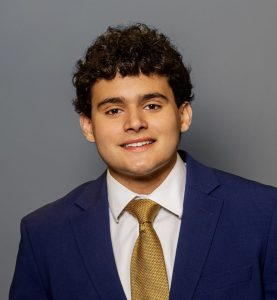
Anthony Morales
Government Affairs Intern
anthony.morales@northshorechamber.org
Anthony Morales is a rising junior at Providence College, double-majoring in Business Economics and History. At Providence, he is involved in the Economics Club, belongs to the Leadership Fellows Program, and was selected to serve as a first-year class Orientation Leader. As an intern at the North Shore Chamber of Commerce, Anthony’s work focuses on advancing policy and legislation that fosters a business-friendly environment for the region’s businesses and entrepreneurs.
